




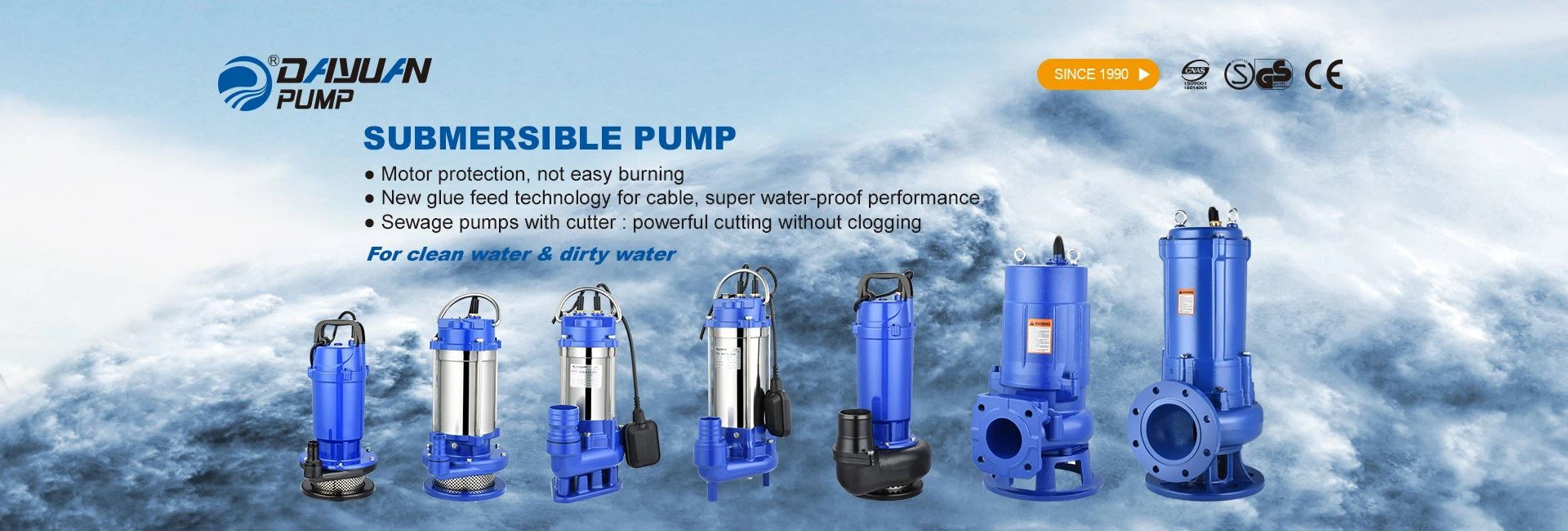
How To Choose A Suitable Submersible Pump?
 Mar 31, 2025|
 If you are a buyer, when purchasing a submersible pump, you can consider the following functions and technical parameters, and combine procurement strategies and risk management to ensure that the product meets actual needs and maximizes long-term benefits:
1. Core functions and technical parameters
● Lift and flow adaptability
Choose the appropriate lift and flow range according to the application scenario (such as deep well pumping, municipal drainage, industrial circulation, etc.). For example:
a) Agricultural irrigation requires a model with a lift of 10-550 meters and a flow of 5-650m³/h;
b) Municipal drainage requires a sewage pump with a large flow and medium lift.
● Medium adaptability
a) Material selection: Select the pump body material according to the characteristics of the conveying liquid (clean water, sewage, corrosive liquid, high-temperature liquid), such as cast iron (economical), stainless steel (corrosion-resistant), titanium alloy (high-salt environment) .
b) Special design: Sewage pumps need to be equipped with cutting devices to handle media containing solid particles; high-temperature pumps need heat-resistant sealing materials (such as hot spring pumps that can withstand temperatures up to 120°C).
● Energy efficiency and energy saving
a) Submersible pumps are directly immersed in liquids and theoretically save 20%-30% more energy than traditional pumps.
b) Prefer motors that meet international energy efficiency standards (such as IE3/IE4) to reduce long-term operating costs.
● Sealing and durability
a) Sealing technology (mechanical seal, double seal) directly affects waterproof performance, and it is necessary to ensure that the motor can operate stably for a long time in sandy or highly corrosive environments.
b) Check the protection level (such as IP68 is the highest waterproof level) for deep water or complex environments.
● Smart monitoring function
a) Smart models with integrated sensors (flow, temperature, vibration monitoring) can warn of faults in real time and reduce the risk of downtime.
b) Models that support remote control are suitable for unattended scenarios (such as deep-sea energy development).
