




What is the specific speed of a vertical pump?
 Oct 22, 2025|
 Hey there! As a supplier of vertical pumps, I often get asked about the specific speed of these pumps. It's a crucial concept that can really impact how well a pump works in different situations. So, let's dive right in and break it down.
First off, what exactly is the specific speed of a vertical pump? Well, specific speed is a dimensionless number that helps us figure out the general shape and performance characteristics of a pump. It's calculated using a formula that takes into account the pump's flow rate, head, and rotational speed. The formula for specific speed (Ns) in US customary units is (Ns = \frac{N\sqrt{Q}}{H^{3/4}}), where (N) is the rotational speed in revolutions per minute (RPM), (Q) is the flow rate in gallons per minute (GPM), and (H) is the head in feet. In SI units, the formula is adjusted accordingly, with (Q) in cubic meters per second and (H) in meters.
Why is specific speed so important? It gives us a way to compare different pumps and predict how they'll perform under various conditions. For example, pumps with low specific speeds are typically better suited for high-head, low-flow applications. These pumps usually have a more radial flow design, where the fluid moves mainly in a radial direction from the impeller. On the other hand, pumps with high specific speeds are great for low-head, high-flow situations. They often have an axial or mixed-flow design, where the fluid has a more axial or a combination of axial and radial movement.
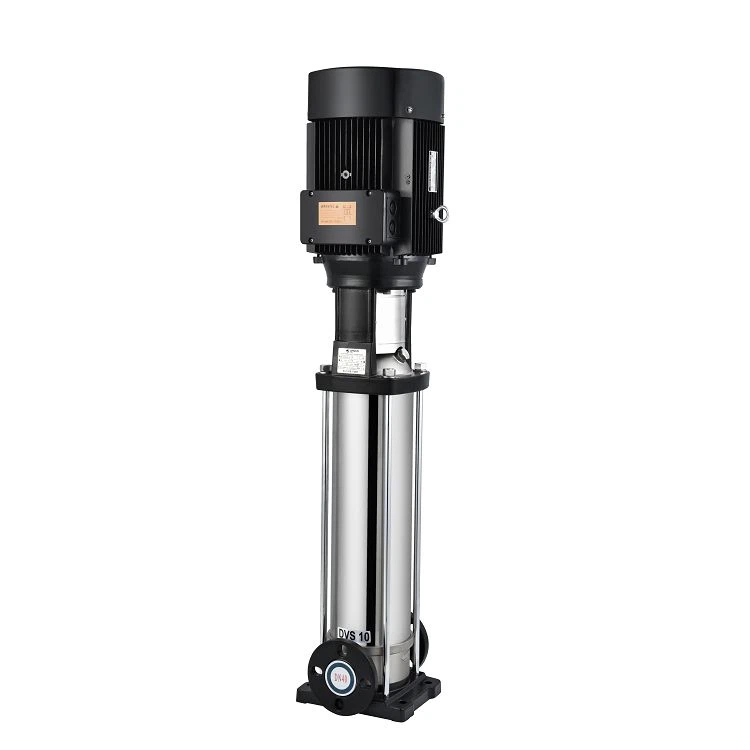
Let's talk about how specific speed relates to the types of vertical pumps we offer. We have a range of vertical pumps, including the Vertical Inline Multistage Centrifugal Pump. These pumps are designed for applications where you need a relatively high head and a moderate flow rate. They usually have a specific speed in the mid-range. The multistage design allows them to build up the head by passing the fluid through multiple impellers in series.
Another type of pump we have is the Light Vertical Multistage Centrifugal Pump. These pumps are often used in applications where space is limited and you need a compact solution. They can handle a range of flow rates and heads, depending on the specific model. Their specific speed can vary, but they're generally designed to be efficient in their intended operating range.
Then there's our Stainless Steel Multistage Centrifugal Pump. This pump is great for applications where corrosion resistance is a concern, such as in the food and beverage industry or in some chemical processing applications. The specific speed of this pump is also carefully chosen to ensure optimal performance for the typical flow and head requirements in these industries.
Now, let's look at how to select the right vertical pump based on specific speed. When you're choosing a pump, you need to consider the specific requirements of your application. First, determine the required flow rate and head. This will depend on factors like the size of the system, the distance the fluid needs to be pumped, and the pressure requirements. Once you have these values, you can calculate the specific speed for your application. Then, you can compare this value to the specific speeds of the pumps we offer to find the best match.

It's also important to consider the efficiency of the pump. Pumps operate most efficiently at or near their best efficiency point (BEP). The specific speed can give you an idea of where the BEP is likely to be for a particular pump. If you operate a pump far from its BEP, it can lead to reduced efficiency, increased energy consumption, and potential mechanical problems.
In addition to efficiency, you need to think about the reliability and durability of the pump. Our vertical pumps are designed and built to last, using high-quality materials and advanced manufacturing techniques. But choosing the right specific speed for your application can also help ensure the long-term reliability of the pump. For example, if you try to use a pump with a low specific speed in a high-flow application, it may experience excessive wear and tear, leading to more frequent maintenance and a shorter lifespan.
Let's take a real-world example. Suppose you're in charge of a water supply system for a small building. You need to pump water from a well to the building's storage tank. You've determined that the required flow rate is 50 GPM and the head is 100 feet. Using the specific speed formula, you calculate the specific speed for this application. Based on this value, you can look at our range of pumps and find the one that's best suited for your needs. Maybe the Light Vertical Multistage Centrifugal Pump would be a good choice, as it can handle the flow and head requirements efficiently.
In conclusion, understanding the specific speed of a vertical pump is essential for selecting the right pump for your application. It helps you make an informed decision based on the flow rate, head, efficiency, and reliability requirements. At our company, we're committed to providing high-quality vertical pumps that are designed to meet the diverse needs of our customers. Whether you need a pump for a small residential application or a large industrial project, we have the expertise and the products to help you find the perfect solution.
If you're interested in learning more about our vertical pumps or need help selecting the right pump for your application, don't hesitate to reach out. We're here to assist you every step of the way and ensure that you get the best pump for your money.
References
- Pump Handbook, Karassik et al.
- Hydraulic Institute Standards